Description
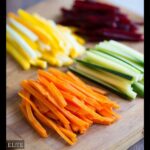
Learn how to perfectly cut vegetables into julienne strips using classic French and alternative methods. This quick and easy guide demonstrates step-by-step instructions to transform carrots, cucumbers, beets, squash, or any similar vegetable into thin, matchstick-sized strips, perfect for salads, stir-fries, and garnishes.
Ingredients
Scale
Ingredients
- 1 vegetable (carrot, cucumber, beet, squash, etc.)
Instructions
- Peel veggies: If julienning a carrot or beet, first peel the outer layer using a vegetable peeler to remove the tough skin.
- Cut into 3 inch pieces: Cut the vegetable into 2 to 3-inch segments, trimming off any root or stem ends to ensure uniformity and ease of slicing.
- Trim off edge: Place the piece cut-side down on a cutting board and slice a thin piece off the rounded side to create a flat, stable base for safer cutting.
- Cut into planks: With the piece flat-side down, slice it into thin planks approximately 1/16 to 1/8 inch thick. Stack a few planks and cut them into similarly thin strips to achieve the julienne shape. Remember to also cut the trimmed edges into strips.
- Alternative method – Cut at a bias: For cylindrical vegetables, start at the root or stem end and cut diagonally at a 2 to 3-inch length with slices spaced 1/16 to 1/8 inch apart.
- Cut into strips: Stack several diagonal slices and cut across them into thin strips of the same thickness to complete the julienne cuts.
Notes
- Always use a sharp knife or mandoline for cleaner cuts and safety.
- Julienned vegetables cook quickly and are ideal for stir-fries, salads, and garnishes.
- Keep your fingers curled under while cutting to prevent injury.
- The thickness can be adjusted slightly depending on the dish’s requirements.